
Benewah County Criminal Court Cases
Benewah County District Court and the Magistrate Division sit in Idaho's First Judicial District. District Court tries felonies. The Magistrate Division handles misdemeanors and infractions, plus initial appearances and preliminary proceedings in felony matters. Judge Barbara Duggan is listed for District Court, while Judge Rachel Hamilton handles the magistrate docket and the Benewah Felony Drug Court.
The clerk at the Benewah County court office is custodian of the local case file. No separate criminal municipal court was found for St. Maries, Plummer, or Tensed. City cases enter the unified state system and are heard in the county Magistrate Division. That distinction matters when a city police report leads to prosecution: the police agency keeps its narrative, but the clerk keeps the filed court record.
The official county court page shows the local office and judges. The image below preserves that source as a visual reference.
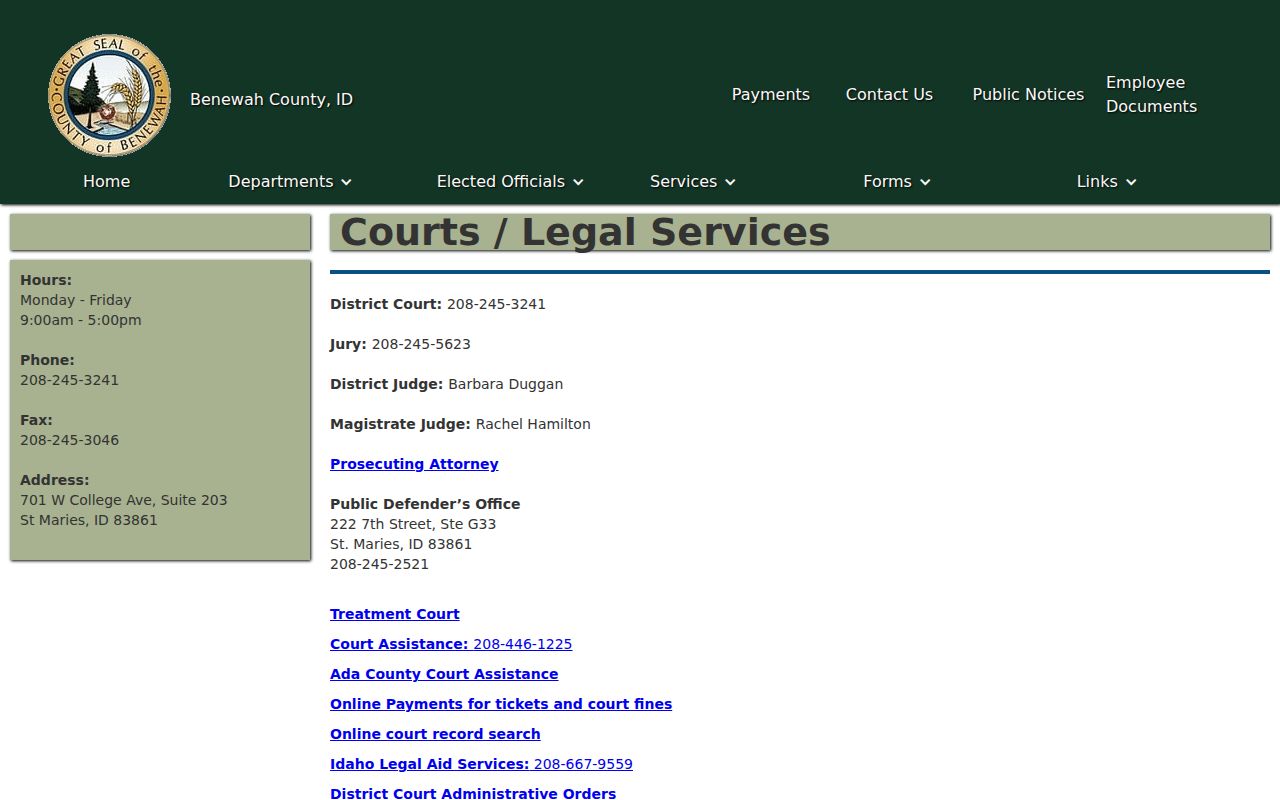
Use the court office details to confirm a file request rather than treating a web result as the full record.
Benewah Court Roles Compared
The local split follows the level and stage of the charge. A misdemeanor can remain with the Magistrate Division from arraignment through disposition. A felony begins there for the first appearance and probable-cause review, then moves to District Court after bind-over. Bind-over means the magistrate found enough support for the felony matter to proceed; it does not mean guilt was decided.
The Idaho Courts description of District and Magistrate Courts supplies the statewide structure behind that local division. Its source image helps place Benewah's two trial functions within one unified system.
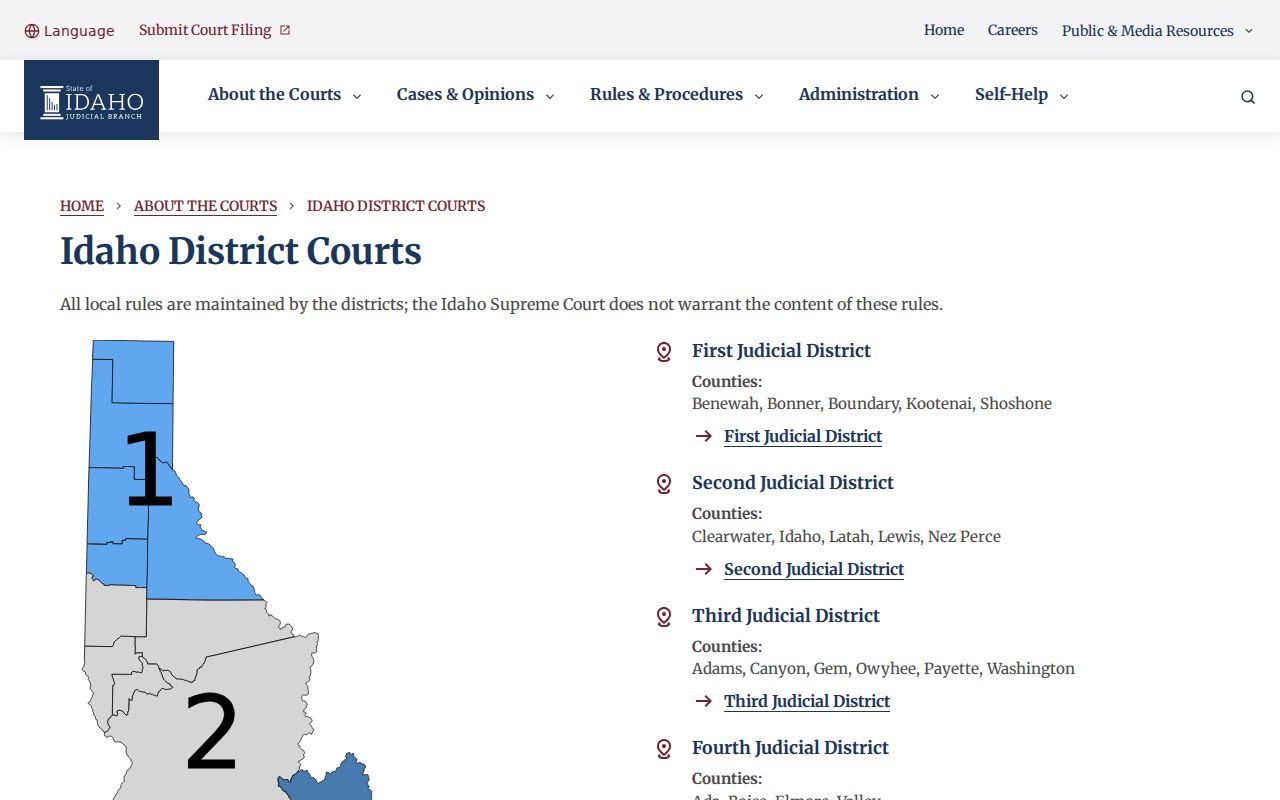
This shared structure is why a St. Maries or Plummer criminal matter does not require a separate municipal-court portal.
Searching Benewah County Case Records
iCourt Public Portal is the main statewide public search. An exact case number is the strongest key. For a person, the official syntax is Last, First; first-name-first may return no results. A wildcard needs at least four letters before the asterisk. No guaranteed refresh time or Benewah historical cutoff is published, so an older or very recent matter may require clerk help.
- Open Smart Search and clear any filters left from an earlier query.
- Enter the case number, or search a person as
Last, First. - Narrow a name match with a middle name, suffix, birth year, court location, case date, and charge.
- Open the case and inspect charge, bond, disposition, hearing, register-of-actions, and finance tiles.
- Keep the case number and ask the Benewah clerk for the actual public document, certification, or archive check.
| Field Label | Type | Required | Notes |
|---|---|---|---|
| Smart Search | Text | Yes | Case or record number, party, or business |
| Individual | Text | Alternative | Use Last, First |
| Case number | Text | Alternative | Legacy numbers may omit leading zeros |
| Wildcard | Syntax | No | At least four letters plus * |
| Advanced Search | Filters | No | Clear remembered filters for a broad search |
The portal screen shown by the official iCourt source illustrates the statewide entry point.
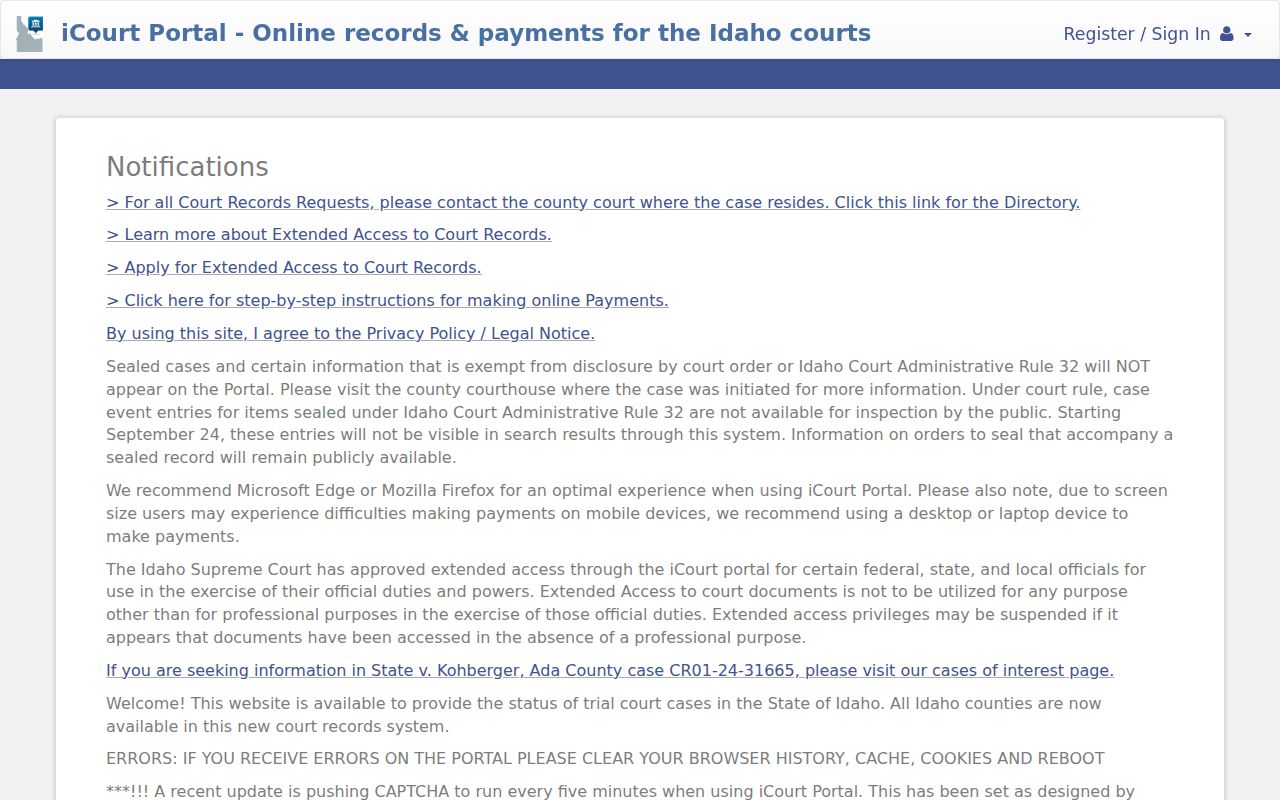
Search results identify cases; they do not guarantee that every pleading can be opened online.
Reading Benewah Case Tiles
The official iCourt public-search tutorial explains how public tiles divide the record. Charge Details identifies each alleged statute and category. Bond Information describes release terms at a stage of the case. Disposition Events show how individual charges ended. The Register of Actions is the dated event list, while Financial Information can show assessed sums and payments.
None of those tiles should be read alone. A bond entry is not the outcome, and an initial charge may differ from the final disposition.
Inside a Benewah County Case File
A court file is built around prosecution, not jail intake. It can contain filed charging papers, public motions and orders, hearing entries, bond information, the judgment, and the sentence. iCourt exposes an index and register-of-actions slice. The clerk or courthouse kiosk is the reliable route to accessible documents that are not offered as public images online.
| Case Number & Court | Stable identifiers for the matter and Benewah court location. |
|---|---|
| Charging Document | The prosecutor's filed allegations, which may differ from arrest charges. |
| Docket Entries | The chronological register of actions, filings, and court events. |
| Hearing Dates | Scheduled or completed events, times, types, and judicial officer data. |
| Disposition & Judgment | How each charge ended and the court's formal decision. |
| Sentence & Conditions | Custody, probation, fines, restitution, and other ordered terms when public. |
Get Benewah Court Documents
Finding a case does not mean every document is downloadable. Idaho Courts directs readers to the courthouse kiosk or clerk for actual records. Take the case number to Suite 203, identify the exact item, and say whether a plain or certified copy is needed. Ask about format, archive retrieval, and the current price before ordering. Benewah County publishes neither an ordinary copy fee nor an archive cutoff, so a borrowed statewide or appellate fee would be unreliable.
The Idaho Courts record-access channels distinguish online data, courthouse terminals, and clerk requests.
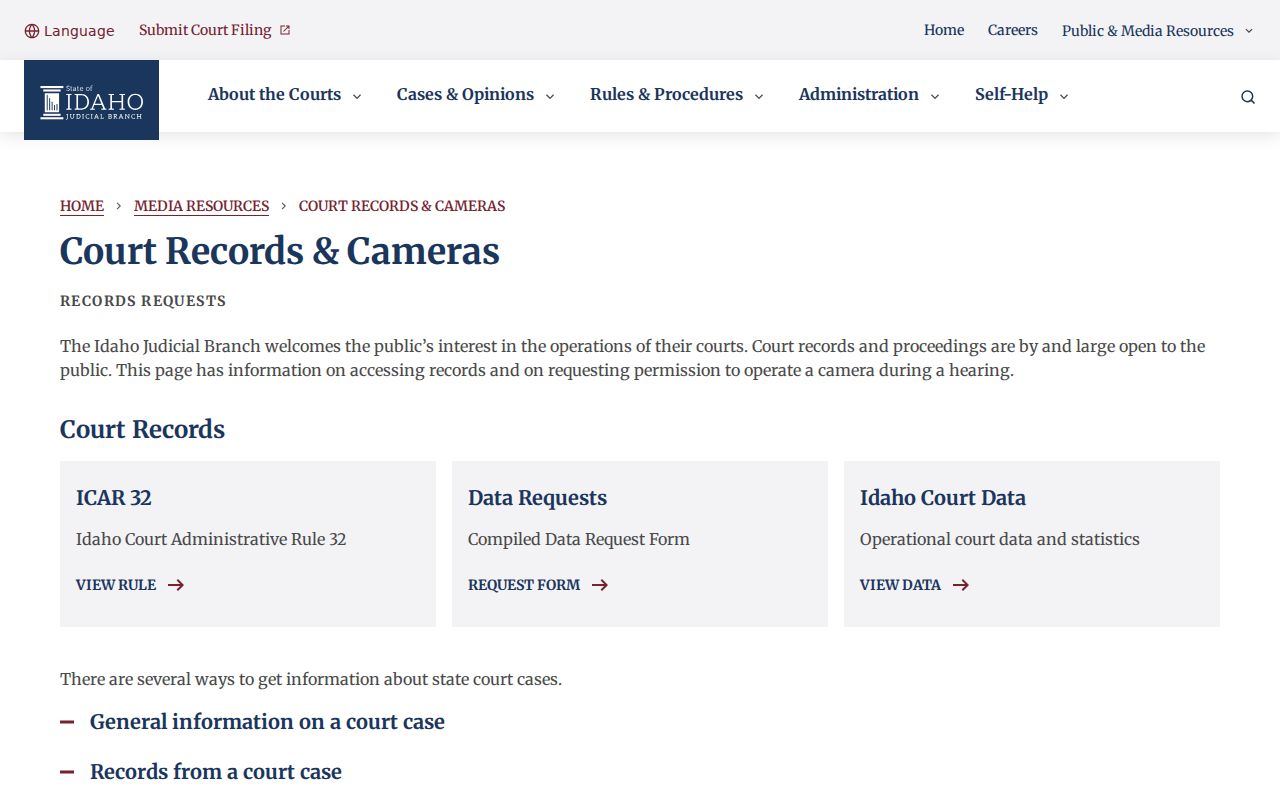
That source supports a practical rule: preserve the linked case number, then let the clerk confirm what is public and available.
How a Criminal Case Moves
After an arrest or citation, the prosecutor decides what to file. A custodial defendant receives a prompt initial appearance addressing rights, release, bond, and any no-contact terms. Misdemeanor cases continue in Magistrate Court. A felony receives preliminary proceedings there before bind-over to District Court, followed by arraignment, motions, and a plea or trial. No fixed local duration was published, and calendars vary by case.
Case flow: Charges Filed › Arraignment › Pretrial › Plea or Trial › Disposition › Sentencing
Benewah Charges and Outcomes
Three labels can describe the same event at different times. An arrest charge is the officer's allegation when custody begins. A filed charge is the prosecutor's allegation in court after review. A disposition is the court record of how that charge ended. Those entries may differ without any database being wrong. The prosecutor can decline a count, file another statute, or amend an allegation as facts are reviewed. The court can then dismiss a count, accept a plea, or record a verdict.
Read the Charge Details and Disposition Events together. “Dismissal” means the charge ended without conviction. “Acquittal” is a not-guilty result. A “withheld judgment” is an Idaho disposition that can support later relief, but the phrase does not mean the history automatically vanished. A sentence follows conviction and may include custody, probation, fines, or restitution. Each count can have a separate result, so a case-level label is not enough when several charges appear.
- Arraignment
- The hearing at which the filed charge and plea are addressed.
- Bind-over
- Transfer of a supported felony matter from Magistrate to District Court.
- Register of actions
- The chronological iCourt list of case events.
- Disposition
- The recorded way an individual charge ended.
Identity needs the same care. A common name can return several people. Compare the birth year shown when supplied, Benewah court location, dates, middle name or suffix, and the underlying charge. A four-letter wildcard is a discovery aid, not positive identification. For a record used to correct one's own statewide history, a certified clerk document supplies stronger disposition proof than a printed search-result screen.
Benewah Felony Drug Court
Benewah's specialty docket is a concrete local feature, not a separate public case system. Judge Rachel Hamilton handles the Benewah Felony Drug Court, and coordinator Mark Martin is listed at 208-245-4065. The underlying public court events remain tied to the clerk and iCourt, subject to the same access rules as other eligible records.
Specialty-court participation should not be inferred from a charge label. Check the register of actions and actual order. The program contact can answer process questions, while Suite 203 remains the file custodian.
Case Record Access and Restrictions
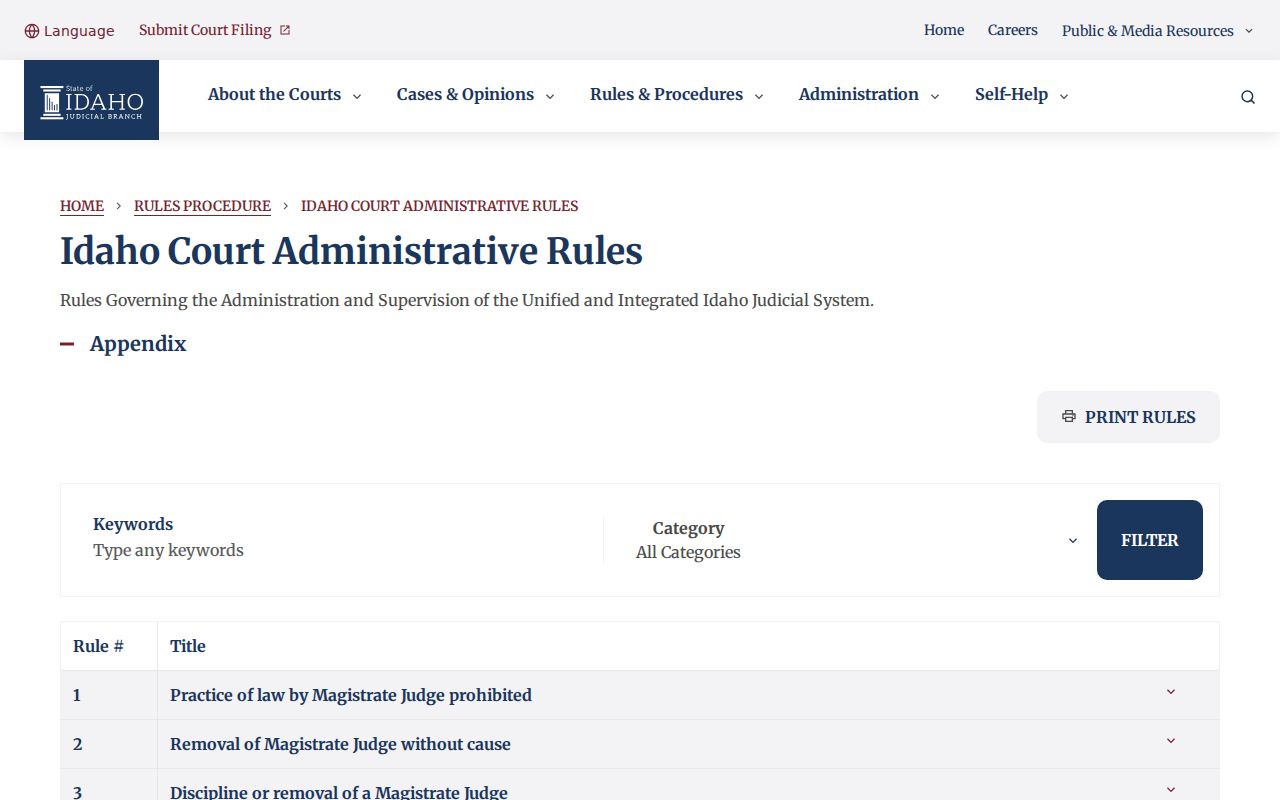
Idaho Court Administrative Rule 32 governs judicial records. Public access can include indexes, filing lists, registers of actions, calendars, public orders and judgments, open transcripts, pleadings, and eligible evidence. Exempt material includes presentence reports, pretrial risk assessments, confidential identifiers, unreturned warrants, juvenile information, and other protected records. A shielded file remains available to authorized users but not the public.
The official rule source pictured below is the authority for court access, rather than a sheriff request under the Idaho Public Records Act.
iCourt shows no sealed placeholder. A no-results response can therefore mean no match, a search-format problem, or sealed and exempt data. Call the clerk about a known case instead of treating silence as proof that no case exists.